 |
Historic Camera
Collector Club
|
The Historic Camera Collector Club, HCCC, is established to help members meet and share common interest, through the exchange of communications and the archiving of information about photography history and collecting.
|
|
|
| VOL 3, Q1 2003 |
An International History
|
Quarterly News Letter
|
| Available By Membership |
Camera and Photo Collecting Club
|
http://www.HistoricCamera.com |
|
|
|
|
The Hawk-Eye Camera.
The camera of which illustrations are shown here-with, is one of the latest claimants for public favor, having been upon the market for less than two years. In that time, however, It has earned an excellent reputation as an efficient and convenient Instrument.
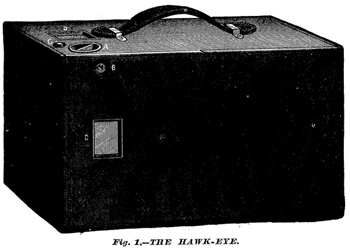
Our readers are so familiar with the instantaneous and automatic features of tile cameras that have done so much to popularize the beautiful art of photography, that we need make no digression in this place to refer to them, further than to say that the Hawk-Eye possesses these features, and others, which combine to make it a good all around camera, exceedingly simple in operation, and capable of yielding the finest results. Its capacity may be summarized by the statement that it is a detective camera, a view camera, an instantaneous camera, an automatic camera, and a magazine camera. The medium for receiving an impression in the camera may be either the glass dry plate, the cut film or celluloid plate, and the celluloid film in rolls for continuous exposures; and the capabilities of the Hawk-Eye will be understood by the statement, that, with its aid, it becomes possible to utilize any or all of these mediums at pleasure. Those who desire to examine at once the results of the work, will use the glass or celluloid plates and do their own developing and finishing, while the tourist will use the continuous roll.
The details of construction and action of this instrument will be fully understood from the following description, reference being made to the figures;
Fig. I shows the Hawk-Eye closed ready for use, the holders containing the sensitized plates or films being inserted in position. Simply turn be revolving plate A sets the shutter at any desired tension or speed, the graduations being shown upon the scale B. A touch upon the button C opens the shutter for a fraction of a second, during which the impression of the picture to retained, a quick-acting lens being located behind the shutter. The object to be photographed is shown in miniature upon the finders D D, one for upright, the other for horizontal pictures, A focus index E Is graduated for 10 to 100 feet and beyond, and controlled by the screw F, fig 2. No fixed focus lens will make a clear picture at all distances, and this adjusting feature, which requires but an instant to operate, is a great advantage in securing fine results.
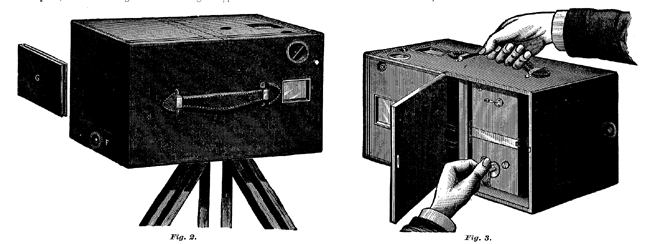
For The use of the tourist or the amateur, the Hawk-Eye is supplied with a roll-holder magazine containing a roll of sensitized film for taking 100 pictures without reloading, The method of operating the camera is the same as before described, but Instead of loading and unloading plate-holders with the separate dry plates, it is only required to wind a fresh portion of the roll of film into place for each' picture by turning the key of the roll-holder, as shown in Fig. 3.
The Hawk-Eye may be set upon a tripod, or any convenient resting place, for time exposures, the shutter being held open at the half - way catch and closed by means of a button, obviating the use of a cap over the lens. Upon removing the back cover G, Fig. 2, the view is seen in full size upon the ground-glass screen inside, and the focus adjusted with the screw F. which operates like a rack and pinion.
From the foregoing description, the adaptability or this camera for a variety of service will be manifest. It is manufactured by the Blair Camera Company, 471 to 477 Tremont street, Boston, with branches at 116 William street. New York, 206-208 State street, Chicago, and 918 Arch street, Philadelphia.
|
|
|

