Search Database

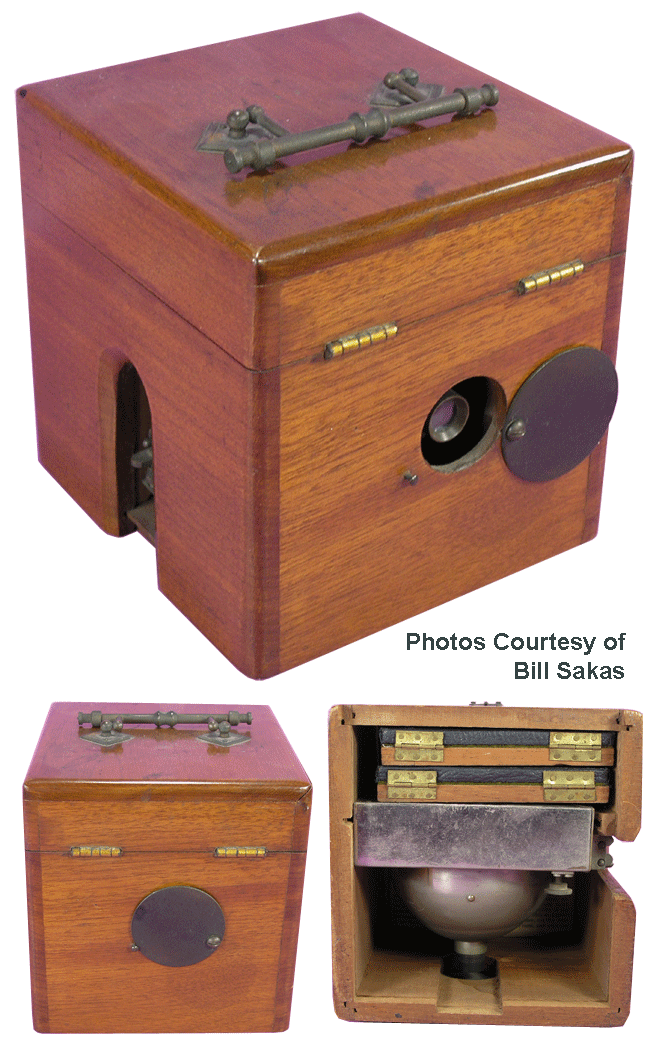
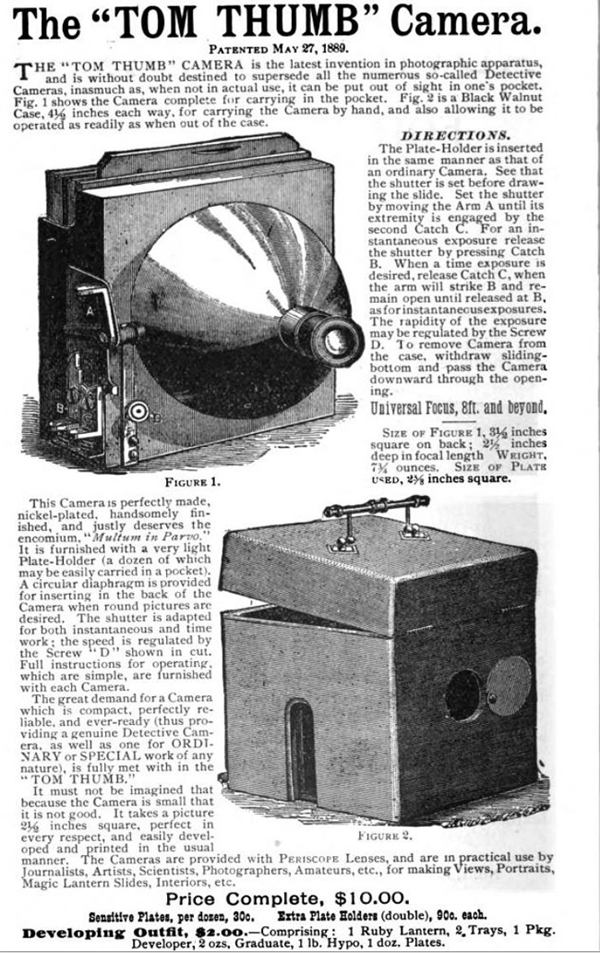
The Tom Thumb detective camera was designed by James H. Ford and manufactured by Max Juruick in Jersey City, NY. It was first introduced in the summer of 1888. Its Patent, No. 403,994 Photographic Camera, was submitted by James H Ford York NY and Max Jurnick and approved on May 27, 1889. At that time J. H. Ford transferred all rights and titles to the Obrig Camera manufacturing co. of New York. The Tom Thumb detective camera took 2 1/2 inches square images that were sharp beyond eight feet. It also came with an attachment stored in the rear of the case for vignetting the image to a two and a half inch circular photo. The camera was stamp constructed from thin metal and plated with nickel. It came with a Gray Periscope lens mounted on a globular front, similar as used on other concealed detective cameras. It housed a hemispherical rotating shutter with triggers and an adjusting thumb screw. The camera came in a black walnut detective box with hindged cover. It held three plates. The inventors intended improvement was to make a low cost apparatus with a larger picture size then other well known concealed or vest cameras that were currently on the market. The box was compact measureing approximately five inches long by four wide and six deep. It was also practical for making lantern slides.
CLICK HERE for a list of Max Jurnick company cameras.
Historic Camera Value and Rating - Estimating Overall Worth (about)
# 1458
2015-06-09 21:24:17
Copyright © 2002 - 2025 Historic Camera